- Home
- Class pages
- Archived Class Pages
- Home Learning 2021
- P6 Home Learning
- Wednesday 3rd February
- P6 Numeracy 3rd February
P6 Numeracy 3rd February
Area Lesson 3
Today we are learning how to find the area of irregular shapes.
Warm-up activity
Let's begin today by practising our multiplication skills. Download today's "Ultimate Times Tables" worksheet, set a timer for 15 minutes and see how quickly you can fill in the answers. If, at the end of the 15 minutes, you haven't finished, that's okay, you can stop now. Then use the answers to mark your work and record your score and the time taken.
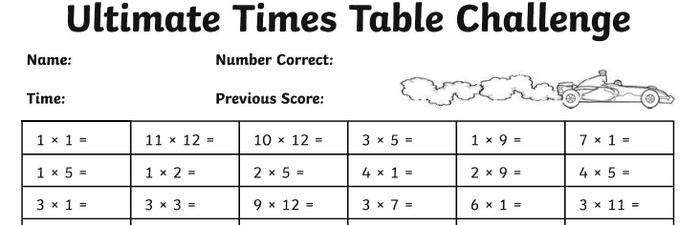
Try to complete as much of the grid as you can without any help. If there are certain tables which you find more difficult, use the "Multiplication Tables Factsheet" to help you and remember to spend some time revising these tables at home please.
Main activity
Over the last two days we have been finding the area of various squares and rectangles.
So what have we learned so far?
- Area measures the amount of surface covered by a shape.
- We measure area in squares. For smaller shapes, we usually use square centimetres (cm²) but for larger shapes e.g. a garden, we may use square metres (m²) or even square kilometres (km²).
- To find the area of a rectangle or square, we can multiply the length by the breadth e.g. if a rectangle measures 5cm by 9cm, its area will be 45cm² because 5 X 9 =45.
But, of course, not every shape is a rectangle or a square so we can't use area = length X breadth every time.
Watch today's video to find out how to find the area of shapes
- which have full squares and half squares; or
- which are irregular
Then select the worksheets for your level (there are two worksheets for each level) and download today's written activities.
Remember
- if a shape has full squares and half squares, count all of the full squares first. Then write ½ in each of the half squares. Two half squares = 1 full square so if I have 6 half squares, that is the same as 3 full squares. If I have 9 half squares, that is the same as 4½ full squares. Add your totals together to get the overall area.

- if the shape is irregular, count all of the full squares first. Then look closely at the remaining squares. If you have half a square or more, continue with your numbering. If you have less than half a square, ignore it. Your final answer will be an approximate area.
- Area - half squares and irregular shapes 3-1-21 - higher level part 1.pdfPDF File
- Area - half squares and irregular shapes 3-1-21 - higher level part 2.pdfPDF File
- Area - half squares 3-1-21 - lower level part1.pdfPDF File
- Area - irregular shapes 3-1-21 - lower level part2.pdfPDF File
- Area - half squares and irregular shapes 3-1-21 - higher level part 1 answers.pdfPDF File
- Area - half squares and irregular shapes 3-1-21 - higher level part 2 answers.pdfPDF File
- Area - half squares 3-1-21 - lower level part1 answers.pdfPDF File
- Area - irregular shapes 3-1-21 - lower level part2 answers.pdfPDF File
Reasoning activity
It's time for today's challenge question so have a go at our logic problem!

Have you been to the Prodigy website yet this week? Lots of you are making amazing progress - well done! If you haven't logged on recently, that's okay - why don't you start today?
https://www.prodigygame.com/main-en/
Remember, your username and password are on our main P6 Home Learning page.